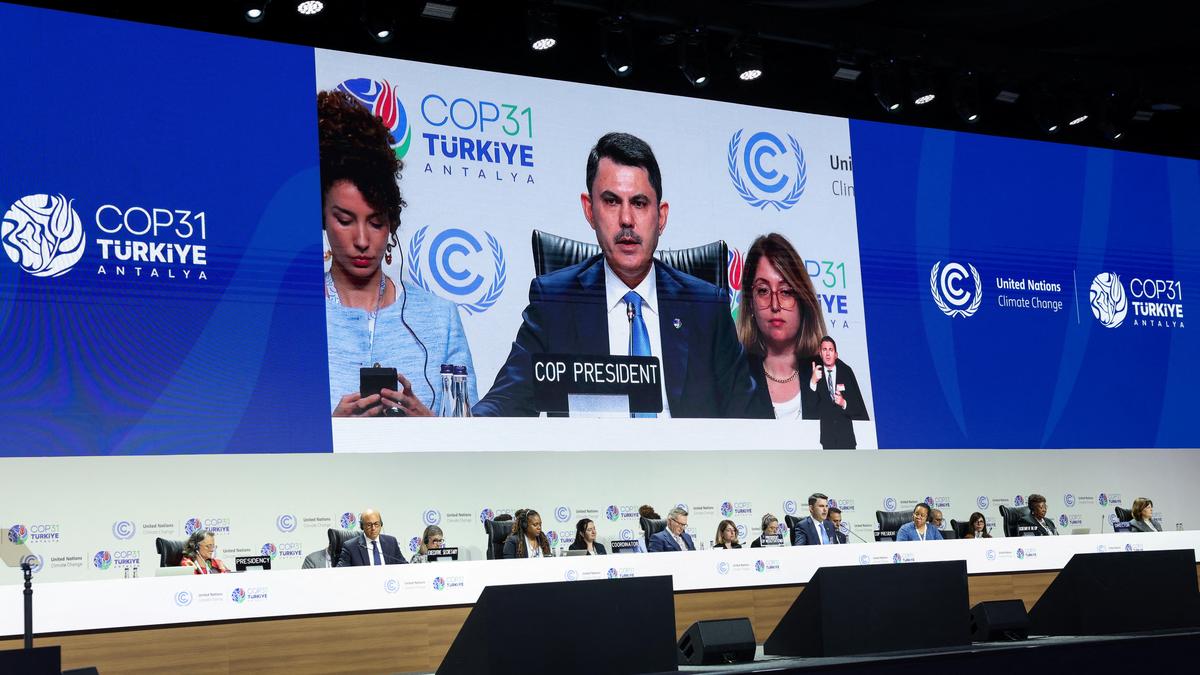
A standoff on a fossil fuel phase-out prevented countries at COP 31, the United Nations climate talks in Antalya, Turkiye, from achieving any consensus agreement on future climate action on Sunday (November 22, 2026), despite the conference running a record 48 hours into overtime.
The European Union led objections to COP 31 President Murat Kurum’s consensus cover text that failed to include any explicit language about moving away from fossil fuels. The EU’s stance was reportedly supported by about 130 countries.

On the other side of the divide, India is among the nations that supported the proposed cover text, as they want to keep using fossil fuels for the foreseeable future, with Environment Minister Bhupendra Yadav stressing that “climate ambition must go hand in hand with means of implementation.”
‘Greenwashes fossil fuel’
“We express profound disappointment with the final draft COP31 cover decision or Antalya Pact. At a point where the world urgently needs action to avert disastrous levels of global warming, the draft cover decision falls well short,” Ireland’s Climate Minister Darragh O’Brien said, speaking on behalf of the EU.
“We will not endorse a decision that does not respond to the science, that disregards the implementation gap, and that actually risks deepening the chasm between global commitments and the action required to correct the overshoot and bring 1.5 degrees back to within reach… We will not accept a COP that greenwashes fossil fuel,” he added.
A cover text is an overarching political decision that frames the outcome of a climate conference rather than settling any single agenda item. It is usually finalised last, and like every outcome, it needs the consensus of all parties.

‘Rollback from earlier deals’
Panama also formally objected to the text, saying that as a country battling droughts and other perilous impacts of climate change, the lack of any commitment to keep the rise in temperatures below 1.5 degrees C with firm action on phasing out fossil fuels was “a setback”.
“Panama cannot support this decision. One, because it repeats previously agreed commitments without closing the gap between reality and what science demands. Two, because it weighs too much upon technologies such as CCUS [carbon capture utilisation and storage] instead of calling for deep changes, and three, because it weakens language agreed in previous decisions. This is a setback, a rollback,” said Ana Aguilar, Panama’s chief climate negotiator.
‘Equitable energy transitions needed’
On the other side, Saudi Arabia, China, and India are among the countries that are against explicit language on fossil fuel and expressed comfort with the way the cover text language was framed, while also expressing misgivings about the lack of clarity on adaptation finance. The countries are part of the Like Minded Developing Countries (LMDC) coalition, who are insistent on the use of fossil fuel in the foreseeable future to further their economies, but have also significantly deployed renewable energy.
Indian Environment Minister Bhupendra Yadav said that India’s voice had shaped the draft COP 31 outcome, especially on food security, livelihoods, and cultural practices recognised in action on methane. However, in a post on X, he emphasised that “climate ambition must go hand in hand with means of implementation. Energy transitions must be nationally determined, just and equitable, backed by finance, technology and capacity-building for developing countries.”

Amandeep Garg, who was leading India’s delegation but speaking in his capacity as a spokesperson on behalf of the LMDC, said on the floor: “Everyone has worked tirelessly, and despite our discomfort with some elements of the text, we are willing to move forward, and continue to engage.” The LMDC expressed “concern” about the principles of equity and common but differentiated responsibility not being adequately reflected, adding that there was a “dilution” of the principle of developed countries taking historical responsibility and meeting their obligations.
“At the threshold of crossing 1.5 deg. C, we have raised a fundamental point – we need to reflect why we are here. Whose emissions, both past and continuing, have exhausted the global carbon budget? The cover decision does not reflect this, and only repeats agreed paragraphs from previous decisions to reflect responsibility and does not connect this with the imminent prospect of exceeding 1.5 deg. C,” he said.
‘Climate action must be anchored in science’
The inability of a COP presidency to pass a consensus text is perceived as a sign of failure but the consensus driven nature of the agreement is such that no country or bloc has veto power and every clause must be unanimously agreed to by all 190+ country representatives.
“Antalya will go down as the first COP held in a 1.5°C overshoot reality, and it has exposed a difficult truth: multilateral climate action cannot move at the pace of the lowest common denominator when parties remain unwilling to compromise on the fundamental challenge of transitioning away from fossil fuels,” said Nakul Sharma, senior policy advisor on India at the E3G climate think tank, said in a statement, “Rejecting the cover decision was not a failure of diplomacy; it reflected the need to protect the credibility of the Paris Agreement and keep global climate action anchored in science.”
Published – November 22, 2026 07:34 pm IST